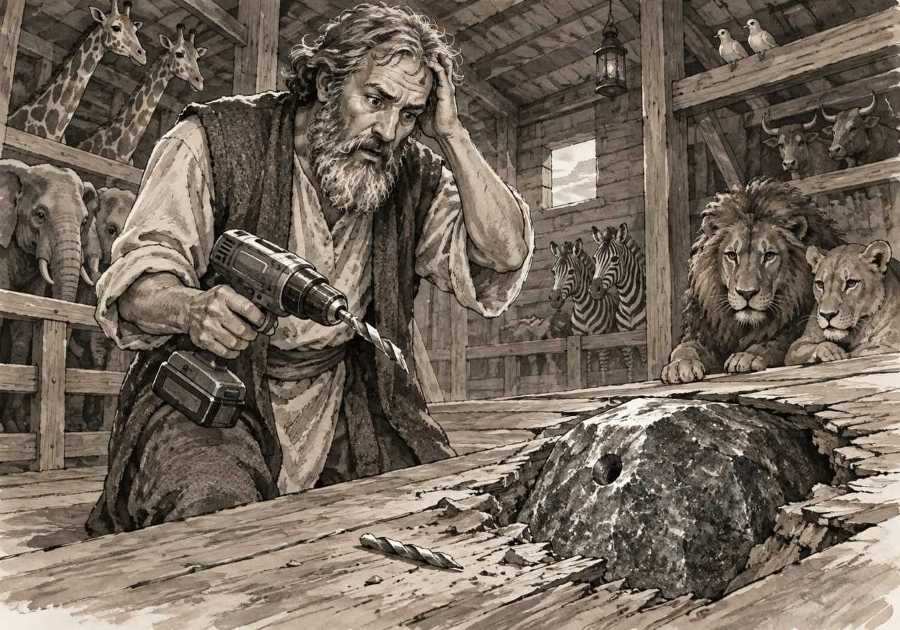
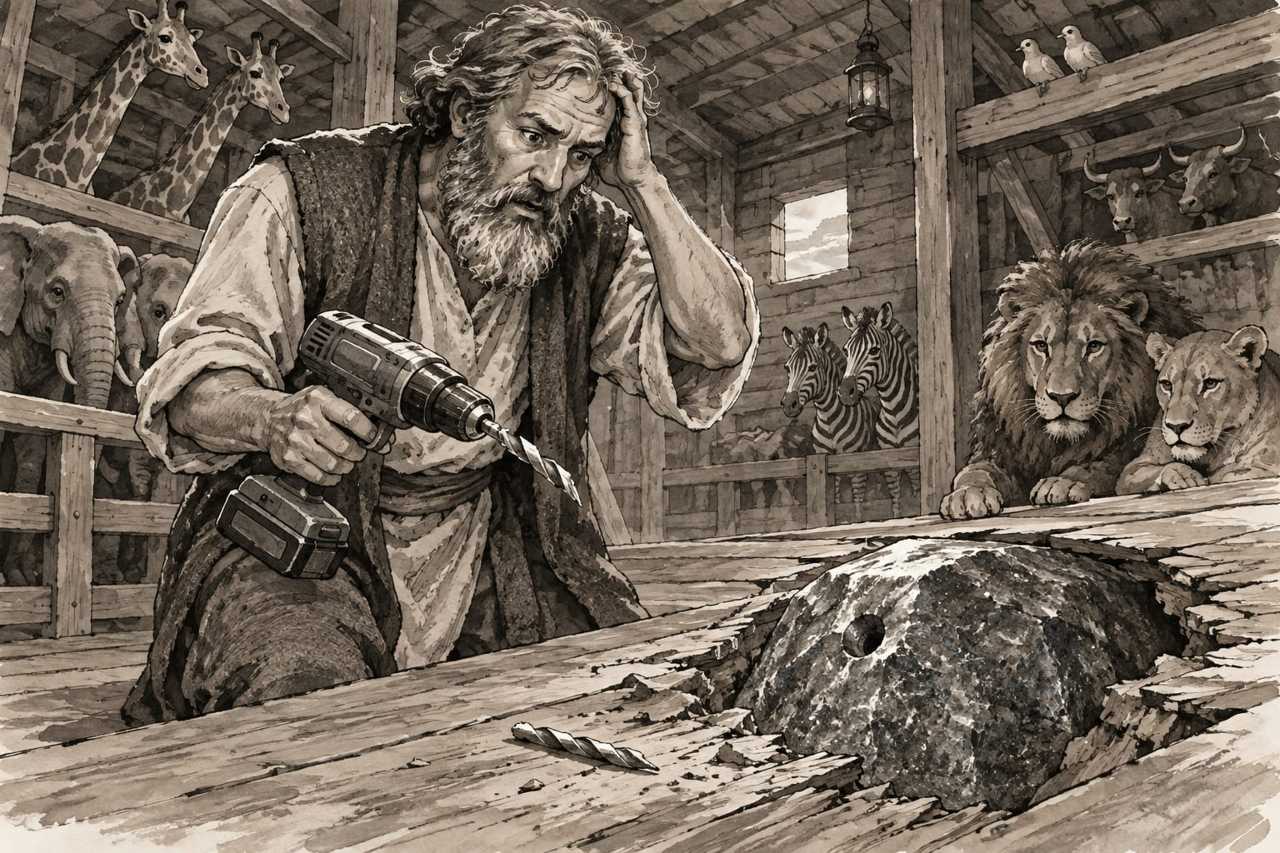
A drill investigating the Durupınar formation in eastern Turkey, long promoted by some researchers and a great many documentary producers as a candidate site for Noah's Ark, has reportedly hit something solid enough to stop it in its tracks. What that something is remains unknown.
That is, as far as the reporting goes, the entire story. A drill went into the ground. It broke, or was stopped, on an object or material nobody has yet identified. No composition, no age, no shape has been confirmed. If you were hoping for a verdict on whether this is finally the boat, you will have to keep hoping.
What's actually new
Here is the honest accounting of what has changed: a physical obstruction was encountered during drilling at a site that has been poked, scanned and argued over for decades. That is it. The obstruction stopped equipment. Nothing in the available reporting says the object has been retrieved, photographed in detail, carbon dated, or analyzed for material composition. No team has announced what it is made of or how old it might be.
Our reviewer, who has sat through more "ark discovered" news cycles than he can comfortably count, treats this kind of update the way he treats every other one from this particular hillside: with a raised eyebrow and a wait-and-see. He has watched this story resurface with satellite imagery, ground-penetrating radar, soil samples and now a broken drill bit, and he has learned that the gap between "the drill hit something hard" and "we found Noah's Ark" is usually where most of the actual science is supposed to happen, and usually where it stalls. Readers come to this site because that gap gets pointed out rather than skipped over.
The Durupınar site itself is not new. It is a large, boat-shaped geological formation in the mountains near the Turkey-Iran border that has drawn attention since it was first photographed from the air decades ago. Its outline, roughly the length attributed to the ark in the biblical account, has been enough to sustain a cottage industry of expeditions, funding appeals, and claims of anomalous readings beneath the surface. Geologists outside that circle have generally classified the formation as a natural feature, a fold or flow of rock that happens to resemble a hull from above. That disagreement predates this drilling effort by a long way and nothing here resolves it.
So what is genuinely new is narrow: a drilling operation at the site produced a mechanical failure or stoppage against something solid underground. That is a fact about equipment and geology, not yet a fact about history or scripture. It is worth reporting because it is the kind of detail that precedes either a real finding or another round of speculation, and right now there is no way from the outside to say which.
What we don't know yet
The list of unknowns here is longer than the list of knowns, which is itself a useful thing to notice. We don't know what the object or material is. Rock formations and large boulders stop drills all the time, and they do not require any flood myth to explain them. We don't know how deep the obstruction sits, what its dimensions are, or whether it has a shape consistent with anything man-made.
We don't know who was conducting the drilling, under what authorization, or what the stated research goals were going in. We don't know whether follow-up excavation, radar imaging, or sample extraction is planned, or already underway, to identify the obstruction. We don't know if independent geologists or archaeologists not affiliated with ark-research initiatives have been invited to examine whatever comes up.
We also don't know the timeline. Is this a recent development or an older detail being recirculated now that interest in the site has flared up again? Stories about Durupınar tend to resurface in waves, often timed to new documentary releases or funding pushes, and a reader has no way from this report alone to place the event in context against the site's long history of claims.
Perhaps most importantly, we don't know what standard of evidence anyone involved intends to apply before calling this anything more than an unidentified subsurface obstruction. Wood preserved for thousands of years under rock and soil in that terrain would itself be remarkable and worth real scientific attention regardless of what it does or does not prove about any ark. But "drill hit something hard" is consistent with wood, metal, compacted sediment, a boulder, or any number of mundane possibilities, and the reporting gives no indication that anyone has narrowed that list yet.
None of this means the finding is nothing. It means it is early, and early is a stage that this particular site has occupied, on and off, for a very long time.
Who should care
If you follow the Durupınar story the way some people follow a long-running mystery series, this is worth a bookmark. It is a new data point in a saga that has produced plenty of them without yet producing a conclusion, and if you enjoy watching that saga unfold in real time, an unidentified obstruction under a boat-shaped mountain is exactly the kind of beat you tune in for.
If you are looking for confirmation of a biblical event, or disproof of one, this is not it. Nothing here settles the geological debate about whether the formation is natural or something else, and nothing here identifies what the drill struck. Our reviewer's advice, after years of watching these announcements land and then quietly fade, is the same as always: wait for someone to say what the object actually is made of, and be suspicious of any claim that arrives before that happens. Hype has a way of filling exactly the space where identification should be, and this story currently has a lot of unfilled space.
Everyone else can safely wait for the next update. If the obstruction turns out to be ordinary rock, you will likely never hear about it again. If it turns out to be something else, this will not be the last article written about it, and by then there should finally be something to actually judge.