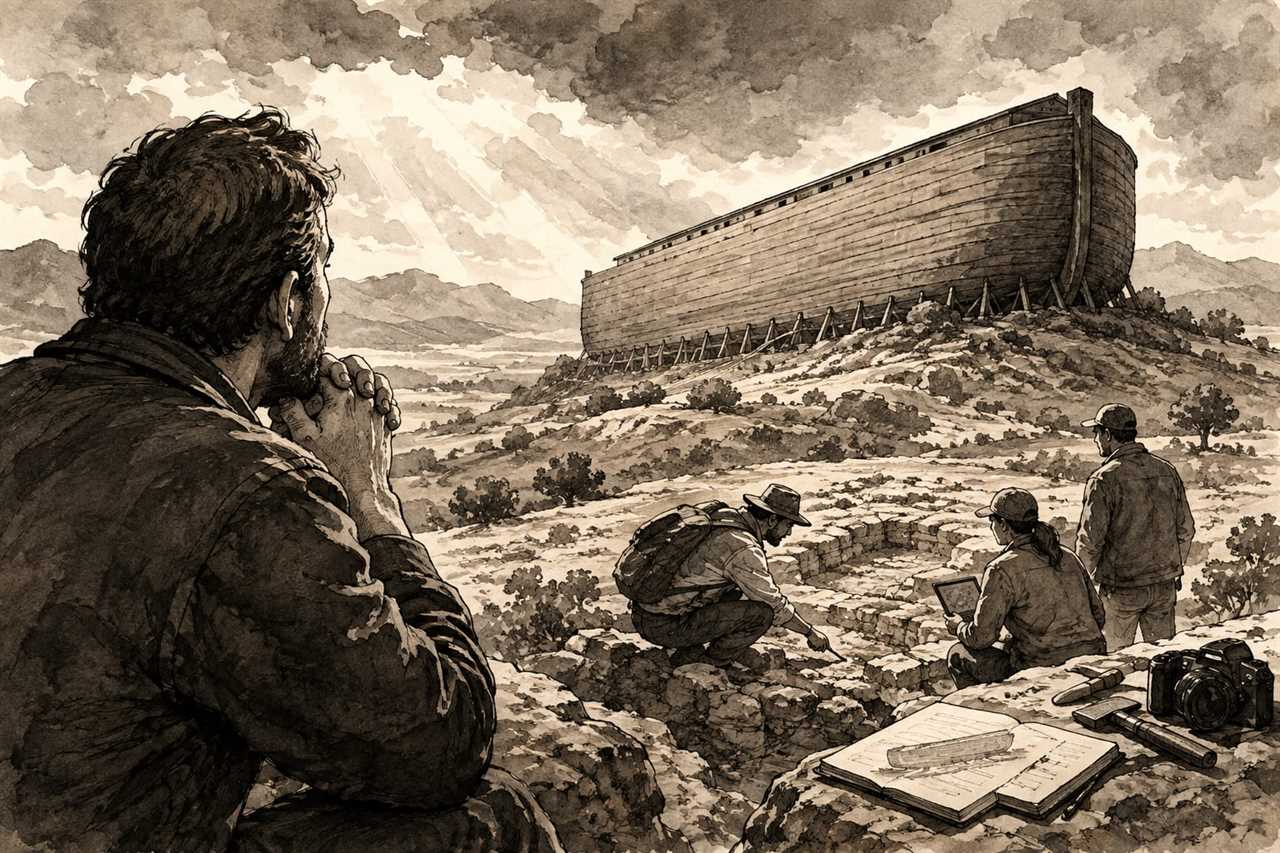
A researcher says buried remains believed to be Noah’s Ark have been found, according to a report from WFLA. That is the whole of what has been announced so far: a theory, attached to a formation somewhere, with the word "buried" doing a lot of heavy lifting.
I have sat through enough of these announcements to know the shape of them before I finish the headline. A researcher, a formation, a claim that fits neatly into a story many people already want to believe. It is not that the story is impossible. It is that "theorizes" is the operative word, and theories about biblical artifacts have a long and mostly unkept history of becoming definitive proof in press releases and then quietly becoming nothing in peer review, if they ever reach peer review at all.
What's actually new
Based on what has been reported, a researcher is putting forward a theory that buried remains at some location correspond to the ark described in the book of Genesis. That is the extent of the confirmed news. Claims like this tend to follow a familiar pattern in this space: an unusual geological formation, often boat-shaped or at least boat-adjacent if you squint, gets examined with ground-penetrating radar or satellite imagery, and the resulting data gets read as consistent with a man-made structure. The most well known version of this kind of claim over the decades has centered on a formation near Mount Ararat in Turkey, which has drawn expeditions and documentaries for generations without producing a result that archaeologists broadly accept. Whether this new report is connected to that site or an entirely different one is not something the current report tells us.
What would count as genuinely new here is if this researcher has produced findings, radar scans, dated materials, or some form of physical sampling that goes beyond visual resemblance. The report as summarized does not say that. It says a researcher theorizes. Those are different claims, and the gap between them is where most of these stories tend to live and die.
What we don't know yet
The basics are missing. Where is this formation. Who is the researcher and what is their background or institutional affiliation. What method was used to identify the remains as "buried," and what, specifically, was found that suggests a structure rather than a natural rock or sediment formation. Has any material been dated, and if so, by what method and to what era. Has the work been submitted anywhere for independent review, or is this a theory offered without accompanying data for outside scientists to check.
Also unclear is the scale of the claim. "Buried remains" could mean anything from a large geological anomaly interpreted through imaging to an actual excavation with physical material in hand. Those are wildly different stories, and the report as it stands does not tell us which one this is. Until there is a location, a name, and some description of the actual evidence rather than the conclusion drawn from it, this sits in the category of claim rather than finding.
I will say this plainly because it is the only fair way to treat a story with this little attached to it: nothing here has been tested, verified, or reviewed in any way the summary describes, so there is nothing to grade on performance. The theory is the entire product right now. That is usually how these stories arrive, and it is usually not how they end up, once actual archaeologists and geologists get a look.
If you follow biblical archaeology or flood-geology debates, this is worth a bookmark and nothing more urgent than that, at least until a location and some methodology show up. If you are the sort of person who has watched a decade of ark-shaped formations turn into a decade of quiet retractions, you can safely keep scrolling. I plan to wait for the part of the story that includes actual evidence before I spend any more words on it, and I would suggest you do the same.