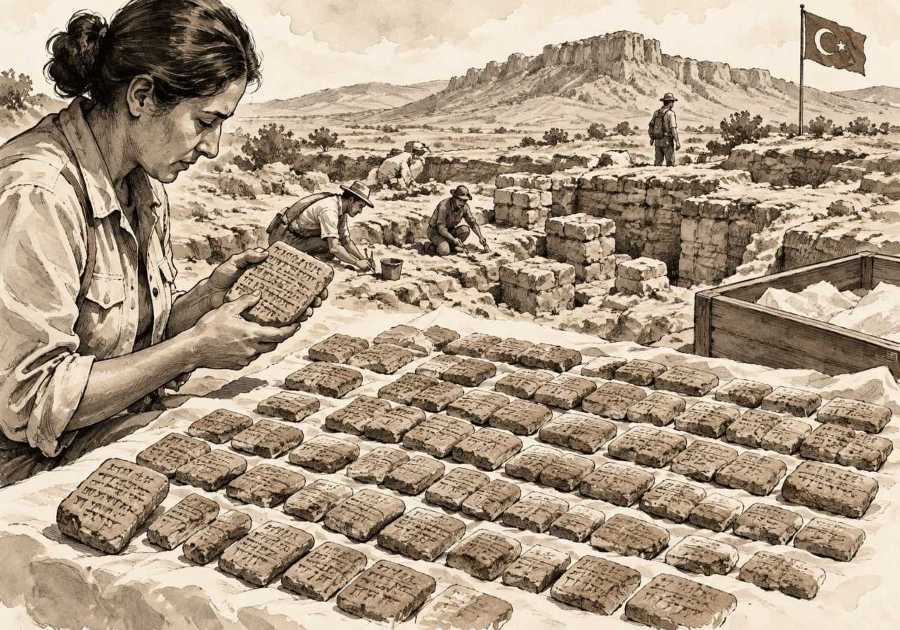

PragerU has published a new video in which Dinesh D'Souza takes on the question of whether archaeology has ever disproved the Bible, distributed through the Howl.link platform.
That is the whole of what has been announced: a title, a presenter, and a publisher. No transcript, no run time, no release date beyond "trending now," and no indication of which specific archaeological claims D'Souza addresses. I have watched enough of these explainer-style releases to know that the headline question is doing most of the marketing work here, and the actual content could range from a careful walk through specific digs and inscriptions to a few minutes of rhetorical reassurance. Until the video itself is in front of me, I am not going to pretend to know which.
What's actually new
Credit where it is due: PragerU has built a real audience for short, opinionated explainer videos, and putting a recognizable name like Dinesh D'Souza on a question this specific, rather than a vague "is the Bible true" framing, is a sensible packaging choice. Asking "has archaeology ever disproved the Bible" is a narrower and more answerable question than the usual culture-war framing these outlets often reach for, and if the video actually engages with named digs, inscriptions, or historical disputes rather than staying at the level of assertion, that would be a genuine step up from the format's usual altitude.
Beyond that, there is not much to point to yet. The distribution through Howl.link rather than a direct PragerU upload is a minor technical note, not a substantive change. It tells us how the video is being pushed around social platforms, not what is in it.
What we don't know yet
Almost everything that would let a viewer judge the claim. We don't know which archaeological findings, if any, D'Souza names specifically. "Archaeology" covers everything from the Dead Sea Scrolls to disputed dating on Jericho's walls to inscriptions bearing on the House of David, and serious scholars disagree about plenty of it. A video can call itself an answer to "has archaeology ever disproved the Bible" while only touching one or two cherry-picked examples, or it can actually survey the contested terrain. The summary gives no hint which.
We also don't know the video's length, its sourcing, or whether it cites actual archaeologists, biblical scholars, or just asserts conclusions in D'Souza's own voice. PragerU's prior output has run the gamut from reasonably sourced to argument-by-assertion, so prior work from the publisher doesn't settle it either way for this one.
And we don't know how the video handles the obvious counterpoint: that "has disproved" is a very high bar, and that plenty of mainstream biblical scholarship holds nuanced positions that are neither full disproof nor full vindication. A video that frames the debate as binary, Bible confirmed versus Bible disproved, is doing something different from one that engages with the actual range of academic opinion. I have no way to tell which this is from a headline and a one-liner, and I am not going to guess on your behalf.
None of this is a knock on D'Souza or PragerU specifically. It is just where things stand when the only material available is a title and a summary line scraped from a link aggregator. I have sat through enough of these "a confident person answers a big question in under ten minutes" releases to know that the gap between the premise and the execution is usually where the real story lives, and that gap is exactly what's missing here.
So: if you follow PragerU's output, or you are interested in how popular apologetics engages with archaeology, this is worth a watch when it crosses your feed, with the usual caveat that short-form video is a bad medium for settling disputed historical claims. If you are looking for a sourced survey of what archaeology actually says about specific biblical events, this headline alone does not tell you whether you are getting that or something thinner. Wait for someone who has actually watched it before you decide the question has been answered.