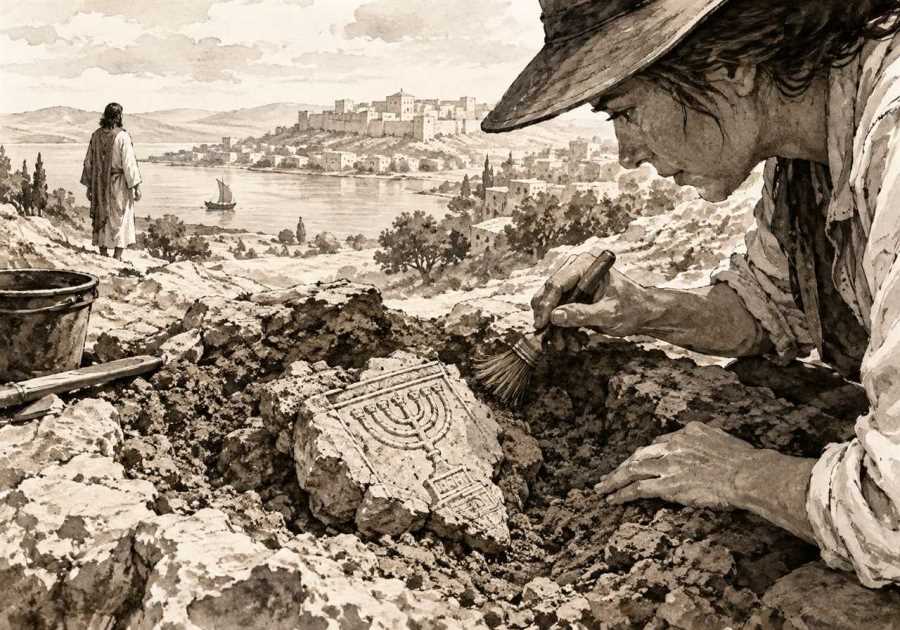
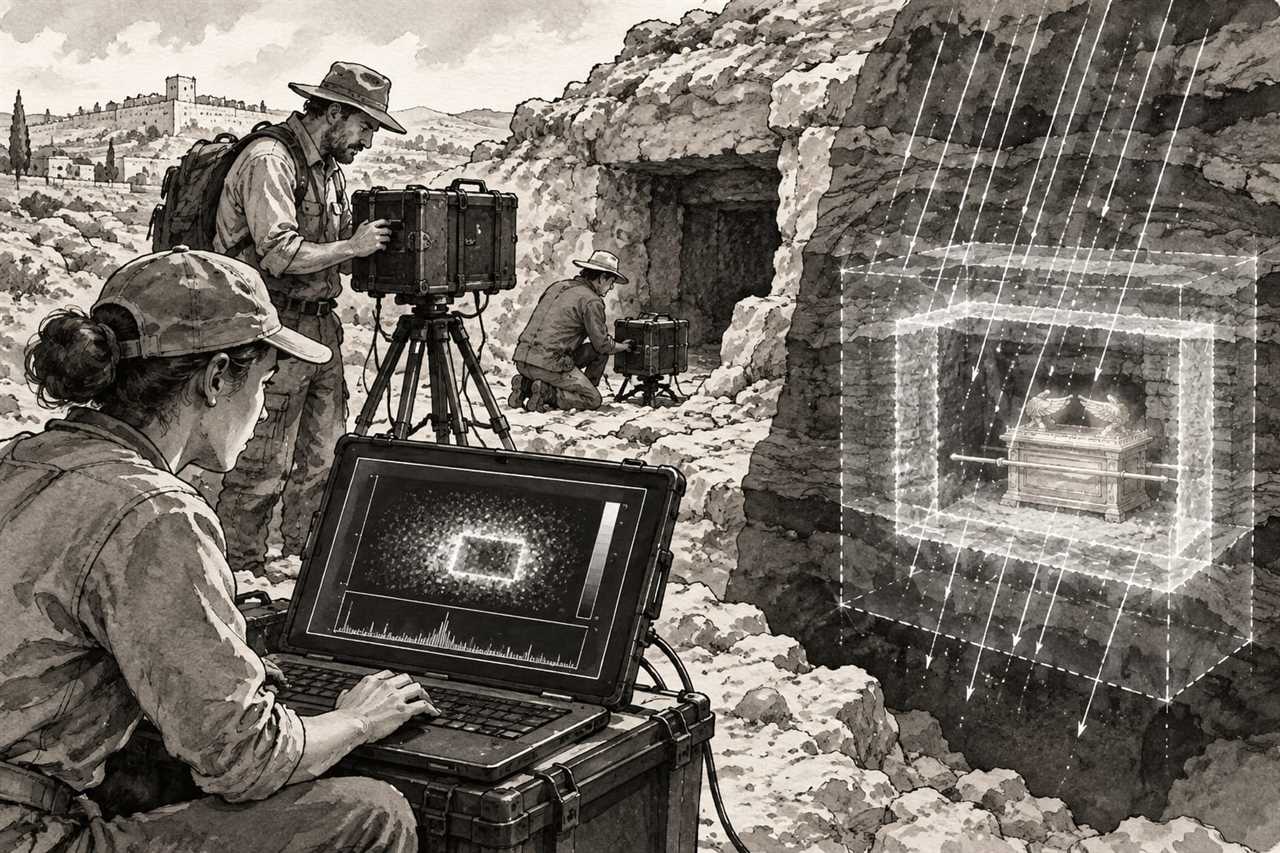
An archaeologist believes the Ark of the Covenant may be sitting in an undiscovered chamber beneath Jerusalem's City of David, and researchers are now using particle detectors instead of shovels to check.
Dr. Chris McKinny has proposed that the relic could be hidden in underground cavities south of the Temple Mount, according to the Daily Mail. The theory is built on old ground, three ancient traditions, including the account in 2 Maccabees, that describe the prophet Jeremiah hiding the Ark and other sacred objects in a cave before the Babylonians sacked Jerusalem in 586 BC. The Ark, said to hold the tablets of the Ten Commandments, was reportedly kept in the Holy of Holies of the Temple until it vanished from the historical record at that point.
What makes this version of the story notable isn't the theory itself, which has been kicking around in various forms for a long time. It's the tool being used to test it.
What's actually new
Researchers have started using muon detectors in the search. These instruments track subatomic particles created when cosmic rays strike the Earth's atmosphere, and they can be used to effectively scan deep underground without digging, flagging hidden chambers or metal objects through solid rock. According to the report, initial scans of the area have already turned up previously unknown voids and structures, which fits with the idea that there may be hidden tunnels under the site.
That's a real development. Most Ark theories go nowhere because nobody can actually get underneath the Temple Mount to check. Traditional excavation there is almost entirely off-limits, for both religious and political reasons, which is part of why the site remains, as the report puts it, one of the biggest blank spots in recorded history. Muon detection, along with other remote sensing methods like ground-penetrating radar and seismic scanning, is apparently the only practical way researchers can study what's underneath without setting off a diplomatic incident.
I've sat through a lot of "we may have finally found it" headlines in my time covering this kind of thing, and the instinct is always to roll your eyes a little. Most of these stories amount to someone with a theory and no way to test it. This one is different in a specific, narrow way: there's an actual sensing technology being deployed, not just speculation dressed up as discovery. That alone is worth noting, even if it's a long way from a result.
What we don't know yet
The report doesn't say what the muon scans have specifically found beyond "previously unknown voids and structures." There's no detail on how large these spaces are, how deep they sit, or whether anything inside them has been identified as metal, organic, or anything at all. No timeline is given for further scanning or for any attempt to physically access these spaces, if that's even permitted. There's also no indication of who is funding this work, which institutions beyond Dr. McKinny's involvement are participating, or when any of this started.
Most importantly, nothing in the report confirms that a chamber matching Jeremiah's hiding place has actually been located, only that the technique used to look for one has found irregularities consistent with the theory. That's a meaningful difference, and it's the kind of gap that tends to get smoothed over by the time a story like this reaches a headline.
Who should care
If you follow biblical archaeology, this is worth watching, mainly because the method is more credible than most of what gets attached to Ark stories. Muon tomography has legitimate uses in archaeology and geology elsewhere, so applying it to one of the most access-restricted sites on Earth is a sensible move, not a stunt.
If you're expecting news of an actual discovery, you'll want to wait. What exists right now is a theory, a plausible historical basis for it, and an early-stage scanning effort that has found anomalies, not answers. That's a reasonable starting point for a long research project. It is not, yet, a find.