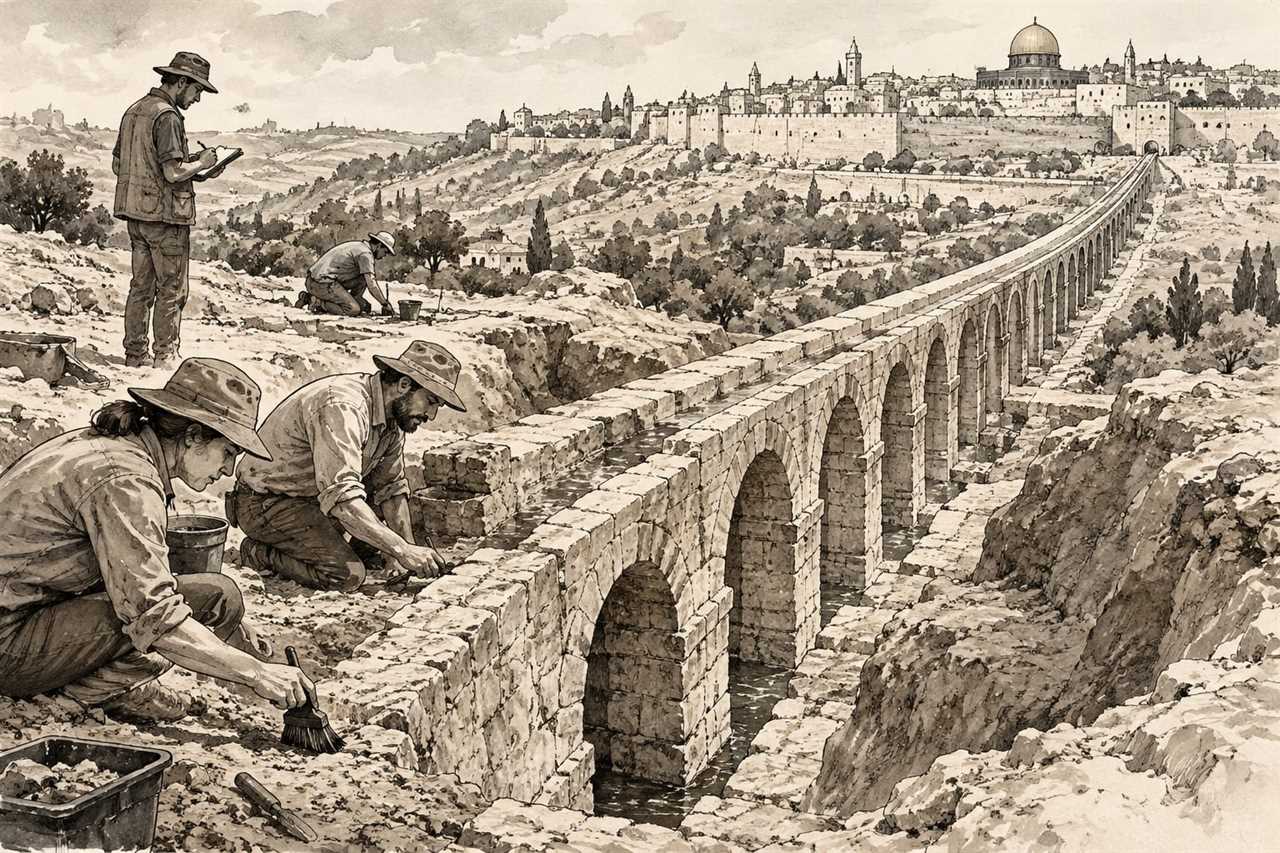
Haaretz reports that archaeologists have uncovered a substantial stretch of an ancient aqueduct that once carried water into Jerusalem, and that researchers are now working through the much harder job of figuring out exactly when it was built and used.
What's actually new
The genuinely new material here is not the aqueduct itself but how the dig team is trying to pin down its age, and that process turns out to be more complicated than popping a shard of pottery into a reference chart. According to the report, Israeli archaeologists have long relied on pottery styles to date sites with real confidence. A Roman cooking pot, a Byzantine vessel and an Umayyad piece are distinct enough that no serious researcher in the field would confuse them.
Plaster is where things get murkier. Researcher Storchan, quoted in the piece, explains that plaster composition shifted over the centuries too, though only to a point. Lime was a constant ingredient across every era, but the finished color could lean more pink in some periods and more gray in others. One layer identified as Umayyad has small pebbles pressed into its surface, a detail that stands out from the surrounding plaster work and gives the team something concrete to point to when sorting construction phases.
Even with those clues, the report is clear that plaster is not a reliable calendar on its own. It is a supporting clue, not a conclusion. And there is an additional complication built into the aqueduct itself: the whole route was originally covered with stone slabs, and those slabs are gone. Without that covering intact, the archaeologists lose a layer of physical evidence that might otherwise have helped narrow down construction and repair periods more precisely.
So the actual advance reported is methodological rather than headline-grabbing. Archaeologists found a long section of the water system, and are now cross-referencing pottery typology against subtle plaster variation to reconstruct a timeline, working around the fact that a key piece of the original structure has disappeared entirely.
What we don't know yet
The source leaves a lot of open territory. It does not say how long the newly revealed stretch of aqueduct actually is, where along its route it sits, or how it connects to previously known sections of Jerusalem's ancient water infrastructure. It does not give a firm date range for when this stretch was first built, only that multiple eras, Roman, Byzantine and Umayyad, appear to be represented in the layers examined so far. It is not clear whether the Umayyad pebble-impressed plaster marks original construction or a later repair job layered onto something older.
The report also does not explain how the missing stone slabs were lost, whether through reuse elsewhere, deliberate removal, or simple erosion over centuries. And there's no indication yet of what dating techniques beyond pottery and plaster comparison the team plans to use, or whether lab-based methods will be brought in to firm up the timeline the visual analysis suggests.
Our own desk has sat through more than a few "major discovery" writeups over the years, the kind where a press release oversells a single trench as rewriting history. This one doesn't do that. It reads like archaeologists being honest about the limits of their own evidence, which is rarer than it should be and worth noting on its own. We'd rather report a team admitting plaster isn't a date book than one claiming certainty it hasn't earned.
Who should care
Anyone following Jerusalem's archaeology or the history of its ancient water systems has a real reason to pay attention here, even without final dates attached. Researchers working on dating methods for Levantine sites more broadly will likely find the plaster and pottery comparison useful as a case study, pebbles and all. Readers looking for a tidy answer on exactly how old this stretch of aqueduct is, or exactly how long it runs, should hold off. That part of the story has not been told yet, and based on what is here, the people doing the digging are not pretending otherwise.