Italian archaeologists excavating at the Church of the Holy Sepulcher in Jerusalem say they have uncovered a stretch of a stone-paved road from the 1st century CE, one that may have led toward Golgotha, the site where Christian tradition holds that Jesus was crucified. That is the finding. The idea that Jesus himself walked it is, by the dig leader's own admission, still just a hypothesis.
The Church of the Holy Sepulcher was built under the Roman emperor Constantine and consecrated in 335 CE, some three centuries after Jesus is believed to have died, around 33 CE. Christian doctrine holds that the church sits on the spot where Jesus was crucified, buried and resurrected. That belief is the backdrop against which this discovery is being read.
What's actually new
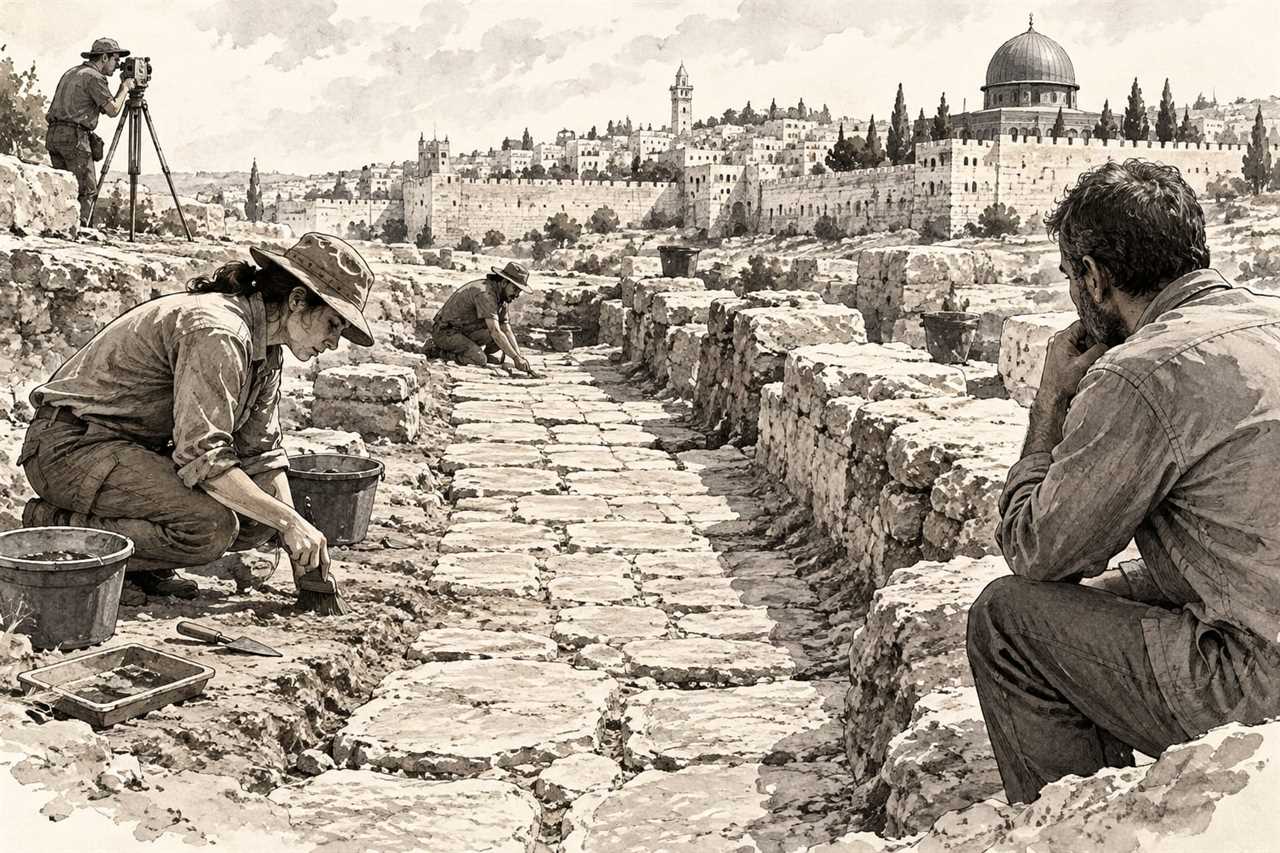
The excavation turned up a section of a wide stone road, roughly 3 by 3.6 meters, dated to the 1st century CE. That places it before Emperor Hadrian's large-scale rebuilding of Jerusalem in the 2nd century, which means the road was already there and in use during the period when Jesus is said to have lived. The researchers believe the road ran uphill in a southwesterly direction, toward the location they associate with Golgotha.
Francesca Romana Stasolla of Sapienza University of Rome, who leads the excavation, is careful to frame this as a possibility rather than a conclusion. The road, in her account, may have led to the site used for public executions in Roman-controlled Jerusalem, which the Bible identifies as the place of Jesus' crucifixion. The archaeologists also note that the road's layout would have suited the kind of large public gatherings that typically accompanied Roman executions, which were deliberately staged as spectacles.
There is a competing, far less dramatic explanation on the table too. The team considered whether the road was simply used to haul building materials. They note that its design would have made that awkward for loaded carts, which is offered as a point in favor of the ceremonial-route theory, though it does not settle the matter.
I have sat through enough "biblical discovery" announcements to know how this usually goes, and I will say plainly that this one is more restrained than most. Nobody here is claiming to have found the road Jesus walked. They are reporting a road, a date range that lines up with his lifetime, and a direction of travel that happens to point toward a traditionally significant site. That is worth something. It is not the same as proof, and the researchers do not pretend otherwise.
What we don't know yet
The exact location of Jerusalem's ancient site of public executions has never been pinned down by archaeologists, despite ancient sources describing mass crucifixions in the area. So even if this road was built for exactly the purpose the team suspects, there is no confirmed endpoint to connect it to. The report does not say what other finds, if any, were made alongside the road, nor does it detail the excavation methods or dating techniques used beyond placing the stones in the 1st century CE. There is also no information here about how much more of the road might exist unexcavated, or what further digging is planned. And the report does not address how this finding fits with, or challenges, other theories about the location of Golgotha that have circulated over the years.
Who should care
If you follow biblical archaeology, or you have a general interest in how ancient Jerusalem was laid out under Roman rule, this is a genuine addition to the record: a dated road, a plausible route, a named researcher willing to call it a hypothesis rather than a revelation. That restraint is rare enough in this space to be worth noting on its own.
If you were hoping for confirmation that archaeologists have found the actual path Jesus walked to his crucifixion, this isn't that, and the people who dug it up aren't claiming it is. Wait for more digging, or at least a firmer read on where Golgotha itself actually was.