Researchers say they've found a way to tell genuine ancient pottery from modern fakes by reading a magnetic signal baked into the clay, one that takes centuries to form and that no forger has figured out how to replicate.
The claim comes from a team led by Yoav Vaknin, a postdoctoral scholar at Scripps Institution of Oceanography in San Diego, working with geoscientists Lisa Tauxe and Jeffrey Gee, along with Brendan Cych, now at the University of Liverpool. Their study appears in Proceedings of the National Academy of Sciences, and it addresses a problem that has kept plenty of disputed artifacts sitting in museum basements rather than on display cases: existing authenticity tests can be fooled.
What's actually new
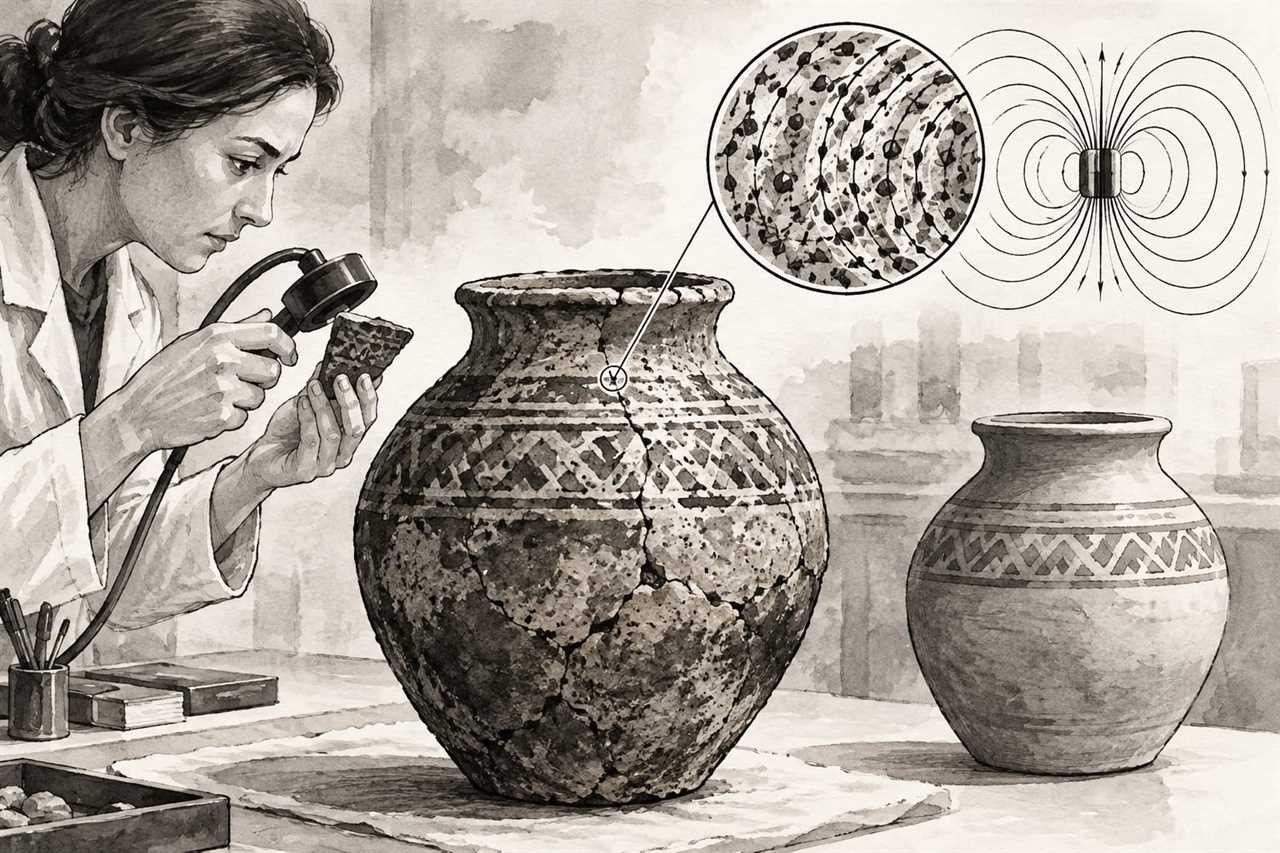
The method relies on something that's been sitting in plain sight in geophysics labs for decades. When clay is fired, the iron-bearing grains inside it align with Earth's magnetic field as the piece cools. Geophysicists have long used that alignment to reconstruct what the planet's field looked like in the past. What Vaknin's team noticed is that a second, weaker magnetic signal builds up afterward, as the smallest grains slowly reorient themselves to match the pot's resting position in the ground. That process takes centuries. Labs doing standard paleomagnetic work usually heat samples just to strip this second signal away as noise. This team instead measured how much heat it takes to erase it, and used that as a clock.
The numbers hold up cleanly enough to matter. Across 45 objects of known age, including 15 royal Judean storage jars, four excavated pottery sherds, and 26 modern pieces (some from traditional kilns, some from electric ovens, some souvenirs bought in Jerusalem's old city), the test sorted every single one correctly. Every modern item lost its secondary signal before reaching 234°F. Every ancient item held onto it past that mark. That's not a marginal result, and it's rare to see a forensic method bat 1.000 on a full test set.
The team also ran the test on three artifacts seized by the Israel Antiquities Authority's Antiquities Theft Prevention Unit from the illicit trade. All three read as genuinely old. One juglet showed a reading hot enough to suggest it had been reheated at some point after its original firing, which the researchers interpret as evidence of a fire in antiquity rather than a forger's kiln.
Crucially, the method closes loopholes that the standard thermoluminescence test leaves open. Forgers can artificially irradiate a new fake to mimic an old glow signature, or grind up a genuine ancient pot and rebind the dust with modern glue to carry over its radiation dose. Neither trick survives the magnetic test, since the glued dust never cooled as a single fired object and the irradiated fake never spent centuries in the ground accumulating that secondary alignment.
What we don't know yet
The cutoff temperature was calibrated for objects presumed older than 1,000 years. Anything younger than that, or a fake made decades or centuries ago rather than yesterday, would need a different threshold, and the researchers haven't worked one out. Readings that land close to 234°F are ambiguous. One genuine jar fragment in this study averaged 240°F, close enough to the line that the authors flagged it rather than called it.
There's also a known blind spot. A genuine ancient pot that sat in the ground in nearly the same orientation it held in the kiln, or one that was caught in a building fire and never moved afterward, could show both signals pointing the same direction. The test can't distinguish that case from a fake. That's why the team is recommending the method run alongside existing tests like thermoluminescence and petrography rather than replace them outright. And the big practical question, how many disputed pieces currently in storage are actually genuine, remains open. The researchers say they plan to run that backlog through the oven next, and eventually bring the readings into court.
This site's reviewer has sat through enough "foolproof authentication breakthrough" pitches to be permanently skeptical of them, and this one at least shows its work: a real sample size, a clean sorting result, and honest admission of where it still falls short. That combination is rarer than it should be.
Who should care: museum curators sitting on undisplayed collections, archaeologists, and law enforcement units chasing the antiquities trade. Everyone else can file this under genuinely interesting science that hasn't yet been asked to solve the easy cases.