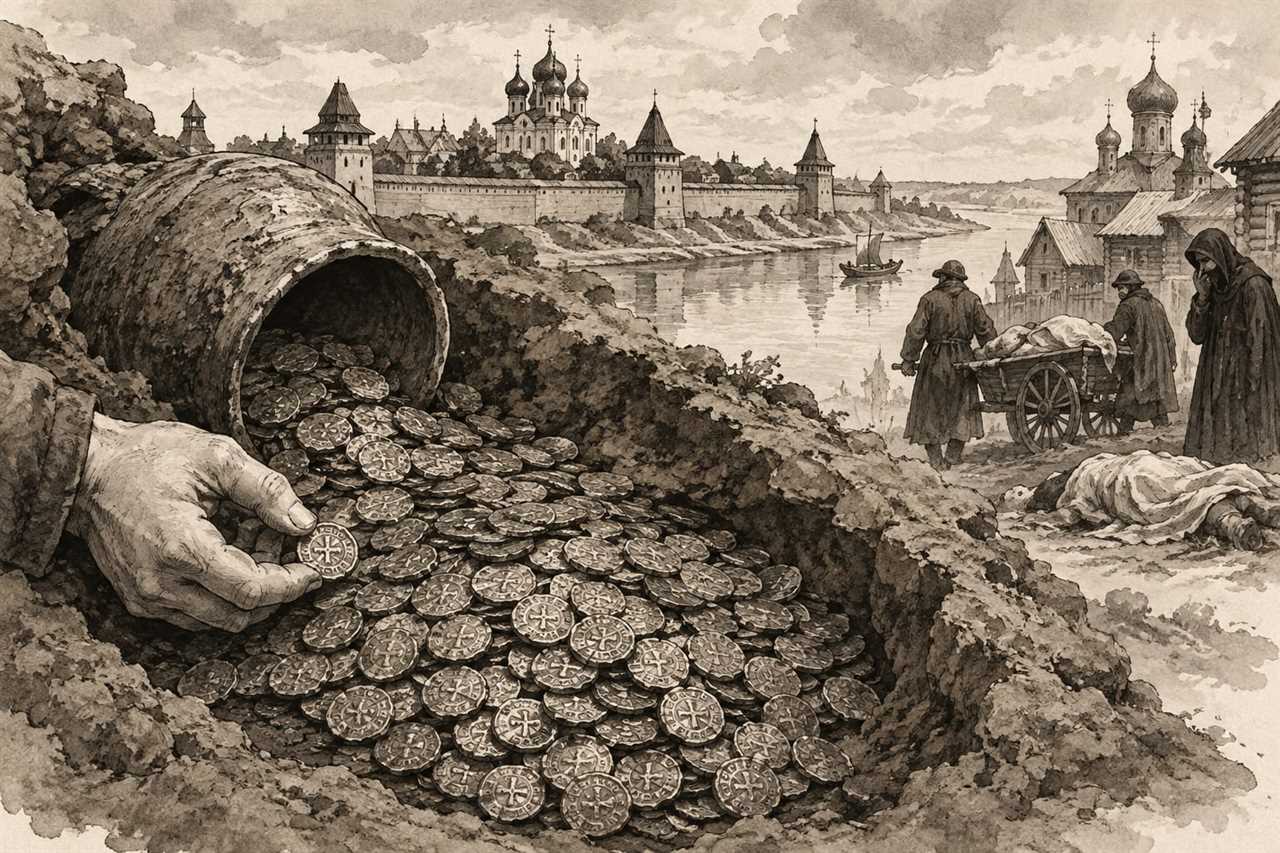
Archaeologists working rescue excavations in Kolomna, outside Moscow, have uncovered a hoard of more than 2,600 silver coins hidden inside a small ceramic jug, the Russian Academy of Sciences' Institute of Archaeology announced late last week. It is, by the Institute's own account, the largest known hoard of silver coins minted in the second and third decades of the 15th century.
What's actually new
The coins are dengi, the denomination that gave modern Russian its word for money, and they were found buried in a shallow pit near what was once the city's trading district. The jug itself was decorated with engobe, a ceramic slip, which is a small detail but a useful one for dating the container alongside its contents.
Most of the coins come from the reigns of two Grand Princes: Vasily I Dmitriyevich, who ruled from 1389 to 1425, and his successor Vasily II Vasilyevich, known as "the Blind," who ruled from 1425 to 1462. What stands out to researchers is what is missing as much as what is there. There is almost no representation of coins minted by appanage princes, the regional rulers who controlled their own territories under the Grand Prince. That absence, combined with the sheer size of the hoard, has led archaeologists to conclude the owner was wealthy, likely part of the upper class of the period.
The dating does the real storytelling here. The latest coins in the hoard were minted in the second half of the 1420s, which lines up with a run of epidemics that swept through Russia between 1425 and 1427. The working theory is that whoever buried this money may have died in one of those outbreaks and simply never came back for it. That is a reasonable inference from the dates, not a confirmed cause of death, and the Institute presents it as a theory rather than a fact.
There is also a genuinely interesting numismatic wrinkle. A substantial share of the coins from Dmitriyevich's reign were struck in Kolomna itself and carry the image of a flying bird, a design that is rare on coins of this period found elsewhere in Russia. Researchers identified more than 350 previously unknown varieties of Kolomna coins within the hoard, along with other coin types that are not represented in the collections of many Russian museums. The find also lets researchers pin down the last Kolomna coins minted with the bird design before it disappeared, giving a clearer endpoint for that particular local issue.
I have sat through a lot of "biggest ever" archaeological announcements, and most of them deflate on a second read. This one does not, mostly because the Institute is careful to separate what the coins prove, meaning wealth and regional minting patterns, from what they merely suggest, meaning a plague death. That is the kind of restraint that is easy to skip past in a press release and hard to fake.
What we don't know yet
The statement does not say who the owner was, only that the pattern of wealth and coin types points to someone of high status. There is no skeletal evidence or burial tied to the hoard that would confirm a plague death. It is inference built on timing, and the Institute treats it that way. We also don't know the total monetary value of the hoard in modern terms, something that was calculated for a separate, unrelated gold coin hoard found in Torzhok earlier this year but was not addressed here. Nor is there any detail yet on what happens to the coins next, whether they will go to a museum, further study, or both.
Who should care
Numismatists and medieval Russia specialists have an unusually rich dataset here, given the hundreds of previously unknown coin varieties. Readers who like a tidy mystery will enjoy the plague theory, as long as they remember it is a theory. If your interest in Russian history stops somewhere around the 20th century, this one is easy to skip.