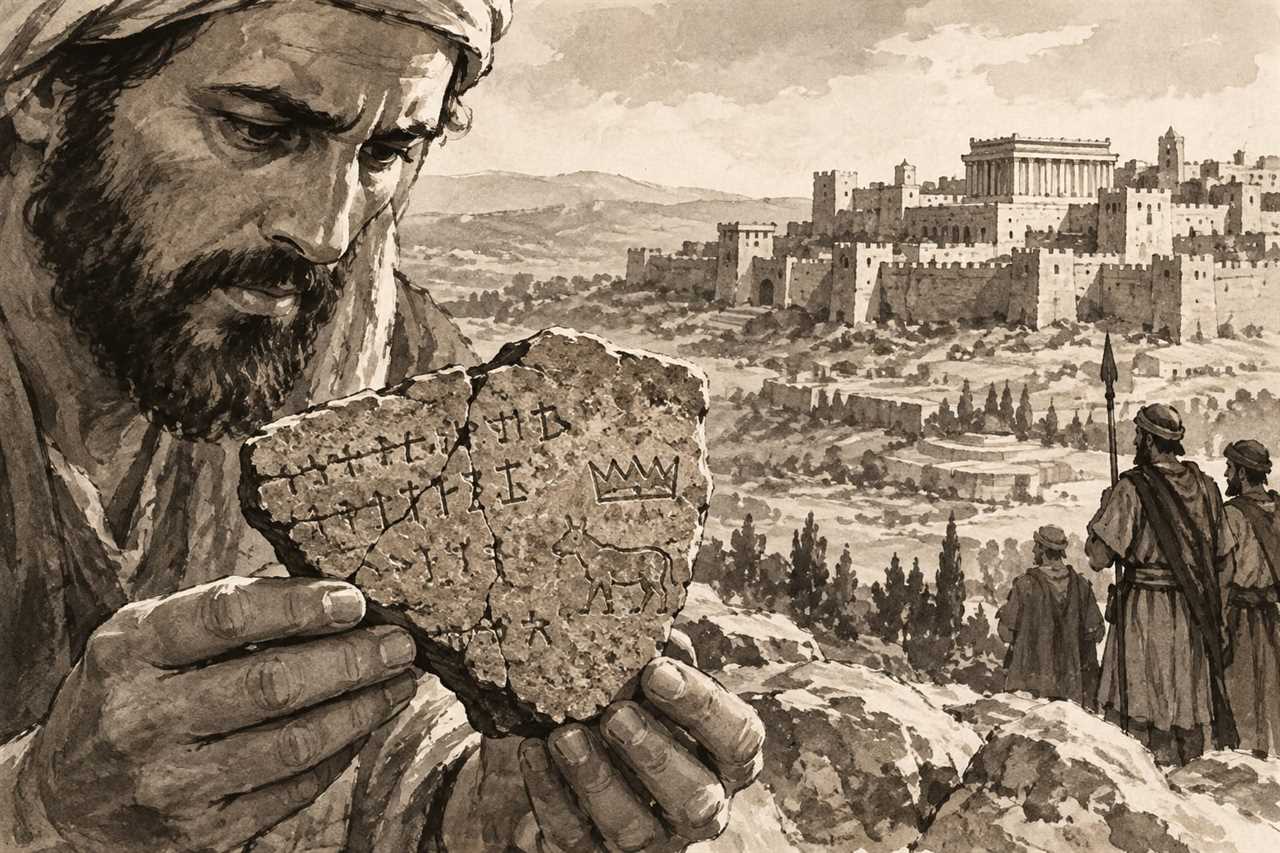
An inscription dated to roughly 2,800 years old has been reported as containing a curse that offers a new detail about the Kingdom of Judah, according to Israel Hayom. That is the whole of what has been shared so far: a headline, a timeframe, and the promise of a "surprising detail." Everything else is still locked behind the original report.
I have been doing this long enough to know that "surprising detail" is doing a lot of work in that sentence. Archaeology coverage runs on the same hype cycle as product launches: a vague teaser goes out, the word "reveals" gets attached to something that may or may not change the field, and readers are left to decide whether to get excited before anyone has shown their work. I don't get excited easily, and I'm not about to start with a curse I haven't read.
What's actually new
Taken at face value, the claim is that an inscription roughly 2,800 years old, which would place it in the Iron Age II period, somewhere in the general era of the divided monarchy, has been identified as containing curse language, and that this curse is said to tell us something previously unknown or underappreciated about the Kingdom of Judah.
That would fit into a real and growing body of evidence. Curses, blessings and oaths are not a novelty in the archaeology of this region and period. Inscribed silver amulets, ostraca and seal impressions from Judah and its neighbors have repeatedly given scholars small windows into religious practice, legal custom and the use of divine names in daily life, often in ways that outpace what the biblical text alone tells us. A newly identified curse formula, if genuine and well-contextualized, could plausibly add a data point to questions about literacy, administration, or religious belief in Judah at that time.
But that is the shape of what's plausible, not a confirmation of what was found. The source material available here does not specify the find site, the object it was inscribed on, who excavated it, who is publishing it, or what the actual surprising detail is. Until that information surfaces, "surprising detail about the Kingdom of Judah" is a placeholder, not a finding.
What we don't know yet
The open questions outnumber the answers at this point. We don't know where the inscription was found or under what excavation conditions, which matters enormously for dating confidence and for ruling out forgery or misattribution, a recurring headache in this particular corner of archaeology. We don't know what object carries the inscription: pottery, metal, bone, stone. We don't know the actual text of the curse or how it was translated, which means we can't evaluate whether the "surprising detail" is a genuine shift in scholarly understanding or a colorful reading of an ambiguous phrase. We don't know which researchers or institutions are behind the identification, or whether the finding has been peer reviewed or is still in preliminary announcement form. And we don't know how the date of 2,800 years was established, whether through stratigraphy, paleography, radiocarbon analysis, or some combination.
None of this means the claim is wrong. It means the claim, as currently presented, cannot be checked. That distinction matters more in archaeology than almost anywhere else, because initial announcements in this field have a well-documented habit of outrunning the eventual peer-reviewed consensus.
Who should care
If you follow biblical-era archaeology closely, this is worth a bookmark and nothing more yet. The eventual publication, assuming one follows, should clarify the find spot, the text and the reasoning behind both the date and the interpretation, and that is the version worth actually reading. If you're drawn in by the word "curse" and the promise of something newly revealed about an ancient kingdom, it's fine to be curious, but hold off on repeating the headline as settled fact.
Everyone else can safely wait. There is no product to buy here, no site to visit, no action required. When the underlying research surfaces with actual specifics, that will be the moment to judge whether the Kingdom of Judah really did give up a secret, or whether a headline writer just found a good hook.